What's the definition of frustration? remember those old jokes of the old days when you were younger & thinks were different, pay to go to the toilets on railway stations, paid a penny & only f*****. Advance in years & the computer age comes along & a new term called Plug & Play, a time when you could add a device to your computer, sometimes needing to take the case apart to do so, but when you fit the new item into its respective slot it ran --- mostly, worst case you were told was you might have to install a driver from supplied disc, problem was the P&P term changed & became Plug & Pray. A bit like that now with Model railways, especially with how models perform & made.
After being out of the hobby for years & coming back, the new fangled thing called DCC & then sound entered the arena, progress has happened to the point where we do not need a masters degree in electronics to install a decoder, so P&P applies in the first instance Plug & Play, whip out the DC decoder from the electonics board in all locomotive models, do some simple???? programing and you run around after your new investment. Happy days in the model railway realm of toy trains having made a step up. Seriously though, is this more a case with Plug & Pray being the best term for our brave new world, that is if you want to go a bit further than plonking and playing trains?
OK! I've started with a negative so sorry about that, thing is though its more a point of frustration than a distinct negative by itself really. I set my layout up in a way that I would like to be as prototypical as possible, the hobby in itself is not a cheap hobby, especially when one sits down & does the sums, and its certainly not getting any better with the cost of models no longer creeping up, but jumping up. For me, in order to restrict costs as much as possible I decided on a very narrow timeline to model in order to avoid tempting purchases, so a period of 1955 - 1958 was chosen after a more constrained earlier period, as it allowed me to have some models that the earlier one would not.
I only have one diesel waiting to arrive and it will complete that fleet of models. The last loco purchase was the Auscision 43cl, a model which I have previously provided photo's of and on the scale of how it looks, the attention to detail and the like, cannot, at least from my perspective be faulted. Up until Wednesday night just passed 7th September, it had not been run as I waited for a sound decoder to be fitted. The ease of being able to install sound decoders these days was a big part of my choice of sound for the 43c, that being a WOW 21 pin with Alco 244 sound in it,
While I did not do the install I watched the process as it was done on the night of our local group meeting, easy enough, get the DC board out, fit the WOW in place, install appropriate speaker into the enclosure, cutting the length of speaker wires then solder to the electrical board. A minimal initial programing to ensure choices were made and then a test run. All worked well & some playing with it along with running a few other trains had for an enjoyable night.
The following day, I decided to do test loads with the model & try the various options available with the wow, while the model ran beautifully, as well as performing very much to my liking, there was one area that truly disappointed me with the model, well its not the model itself but really, an example of poor design that does not do justice to modern sound decoders & the features that are built in to them in this day and age. To many modellers its something that is perhaps irrelevant but for those who desire to run the layouts in some form of prototypical manner it does take away from that aspect that can be easily worked in an operational.
I am referring to the poor lighting arrangements and lack of realistic operating operations available on this model purely as a result of the way the main electrical board is designed. The way it works now is that when the headlight is turned on, it turns on all the lights, that is, headlight, number box, as well as the marker lights, turn the headlight off and all are turned off. The lights are automatically directional, so that on whatever cab is leading, those 3 lights are either all on or off, with white lights at the lead end with red at the trailing end, no independent control of the lights at all.
To many its not likely to be a big deal, but the reality is, at least from my perspective is that it should not have been hard to have the main board designed in such a way that once a DCC decoder, be it a sound or silent type any one with 4 lighting functions available could have readily been able to handle what is correct lighting features of this type & all types of Diesel locomotives, especially the early generation ones as well I suspect modern diesels as well.
Operational requirements for lights basically only changed for diesels in around 1965/66, forget the exact time but it was in that mid 60's time frame that it happened, when a regulation was brought out that ruled the use the headlight on diesel locomotives operating in daylight hours. The regulations that applied to steam locomotives were to be used with diesels, that is the headlight is to be switched on high except inside the Sydney Metropolitan area, inside the border areas, outside those areas the headlights were to be turned off through manned stations, signal boxes when manual changing of sectional staff tokens, when approaching trains running in the opposite direction,
The borders mentioned were Penrith, Cowan, Liverpool, later changed to Campbeltown, Sutherland, inside these areas trains ran under Metropolitan control outside those areas trains ran under the various control boards for the lines. The rule was introduced so that Fettlers & others working on the permanent way was able to see the diesels at a distance, with steam it was easier to see owing to their being smoke in the distance, not just a black blob.
For Steam, dynamo had to be turned off in daylight hours = no lights of any type working. OTOH with diesels when the battery knife switch was closed in order to start the engine, all lights generally came on, exception being the headlight. Cab type loco's such as the 42, 43 etc had engineroom lights some had step & under body lights that stayed on at all times, staff exchanger lights were manual control when the ring was used. Box & Marker lights were also manual operated by on/of switch on the control stands. cab lights an on/off switch at the light assembly. Headlights had either a single rotary 3 position switch, off - dim - high, or a double switch, one being on/off, 2nd one next to the first high/dim.
For a diesel model, all that's needed is that both ends have on off function keys, 1 for headlight on/off. combined on off for marker & box lights, directional lighting could be directional for running either way. The only way to control the 43cl other than by the headlight is by two switches under the fuel tank, that one turns off the headlight with the other the marker lights, meaning you have to manually turn them off using them in MU operations, but you lose all the lights when they are turned off.
I believe that other diesels have similar aspects with them as well, but surely given the time and effort taken in the various people engaged in the research and development aspects of our models, these days in getting the current range of locomotives to the standards they are arriving in, some small amount of time could be put into getting something simple such as the lighting features correct in readiness for either working under DC or DCC operations, both either motor/lighting or sound.
Rather than a plain dumb DC plug as supplied now, why cannot they have the lighting features on the removable board, working through the pin connections for that mode of user operation. Then for those having DCC, again, be it either non sound or sound the lighting features built in to that decoder is used.
I know of modellers who choose to completely strip models of these factory boards & hard wire decoders in to their models rather than trying to alter these boards in order to get the lighting features working. Much Much easier to do it that way than trying to keep the factory boards & modify them. In reality its a waste of a resource that costs the importers as well as the end user money that is for many wasted.
This may seem small as I have said, but the way I see it is that while the importers cannot satisfy every small whim of modellers, with the striving towards getting details correct, its often the small things that end up being the most frustrating, especially when getting that part of the model right, in both detail as well as to how it applied on the railways scene that we are modelling. With diesels, even the older types we have operating representations of most of them, some rail operators allow access to their loco fleets, many modellers work as drivers &/or assistants, and even own model companies so, it should not be hard for these things to be gotten right, even when a dislike for DCC is or was evident at some time.

Meitian - Mongolia 2012 a lovely small village, where steam still existed, and with our heat ATM, this scene looks inviting still CHRISTMASS GREETINGS TO ALL
Monday, 12 September 2016

Wednesday, 1 June 2016
Its pondering time again
Its been a while since the last post, with little if anything happening at Essence, I have taken somewhat of a break from the hobby since Liverpool last year, have had some viral infection for some months that is not shown up in any tests, but seems to have quite a few others up here showing the same symptons of lost of taste, appetite, aches & sweating & not a lot of interest in doing much at all, in other words quite lethargic, & unable to get interested enough to do anything of note, although I did complete 3 trees.
The time actually has been beneficial in other ways though, catching up on some readings in other areas of interest & trying to keep abreast of any happenings in MR world. I guess as I reflect on that point, the happenings to me have not been what one could call positive, & in some ways distressing, in that arena I refer to the Shrike circus that ended as it has. I often still wonder what really is the truth in what happened, aside from several rumours. I admit to being one caught out even though I said no more Early Bird promises & payments after years waiting on some models & still on one, have to keep brushing cobwebs away with that one. Last year at Liverpool I had a very close look at the production sample of a 30Ts model, to me the weight was good, as was the overall detail of it, so I paid & ordered one, now I still ponder as to next steps in regard to it.
One of the aspects that I liked about the 30T was that what detail was on it was fine, as against some of the course detail found on many start up companies models, although I admit to not liking the molded in oil lines along the boiler side which as per other models lacked some what clear definition of the pipes along the sides. Something that seems to be very common with steam models along with trying to get the right number of them on the model, too easy to leave them off & blame cost, yet put other incorrect detail items in to the mold process.
The book reading over the past few months has been revealing also in that I need to make some additional bits to fit onto the 57 & 58 DJH kits, as well but that wont be a big deal except it may impact on some of the paintwork if I'm not careful. The same error sightings on RTR models, has me in a position that as soon as I walk into someone's layout room for the first or any number of times there are some models that I can immediately pick as being from a particular source owing to the very noticeable errors on them. Sadly it has become a bit of a turnoff for me in the interest of modeling.
I was once told that being an ex engineman, that knowing what is correct & what isn't is a curse, well while I disagreed at the time, I may actually be changing my view on that, well up to a point anyway. With time on my hands & the aspects mentioned above I did another serious think on my objectives in modeling, especially in regard to what type of running type models I still need, I rechecked my old desire/want/hope sheet again & while I still have enough models to operate all that I need to do, there are a few holes in models I would like to have, & they are basically so the trains have variety of both goods & passenger RS but also with loco's. The primary empty spots for the later are standard goods loco's (aka freighters as were the common nickname applied to them by enginemen) & a non streamlined 38cl.
With the delays that came with the freighters I decided to get a DJH 53cl kit to build up as a start, with the plan to get the amount of freighters from the source. The model is now assembled & awaiting the fitting of sound, but no hurry with that. When I started the build, with chassis in place & time to work on the boiler, it became very evident that something was seriously wrong, I kept going over the instructions & all the holes drilled out correctly but I was stumbling with the hand rail staunchions, pump location as well as the wire piece that was meant for the exhaust outlet into the smokebox, they simply were wrong for a 53cl. At the same I became aware of what I saw as being very wrong, & that was on the oil lines that ran from around mid high of the drivers side firebox into the cab, & then down to the footplate near the union of the boiler to smokebox.
What was wrong was the oil lines from around mid point through to the cab was a featureless white metal blob molded as part of the whole boiler firebox in one. Not only that but at the mid point down to the footplate rather than a 3 oil line pipes there were 5, as per the 50cl. Thankfully in our weekly model group there is a very good builder of DJH & other models, who I contacted about the problem, when I explained it to him, he replied, OH! I should have realized & given you a copy of the amended plans I did for the 53 & for the 55cl for where to do the drill outs for them, as the boiler unit is set up for a 50cl.
It wasn't until the oil line issue as well as the drill holes were found to be wrong, but the big one was the location of the pump & exhaust lines location on the firebox. The 53 having a higher running boar, had the pump, pipe & all the hand rail, pump line steam pipe & Blower pipe at a completely different spot & higher on the boiler unit. Its all fixe now, except the wrong oil lines on the drivers side, Oh, its no worries really as you cant really notice them or just ignore them anyway. Problem is, that were other lines I had to attach myself as well, for a 53, that being 2 of them on the firemans side & one over the firebox top down to the pump. But for me the problem is that every time I looked at the model, I saw the wrong drivers side oil lines. Knowing they are wrong, I cannot escape from the them. In hindsight I should have got the 50cl kit as would have been happier with it.
Over the past times I was looking forward to another model, still to come, but having seen the final production run photo's of the model I am no longer interested until I at least see the model in the plastic itself, & my eyes will turn to the areas I have deep concerns over. This brings me to another specific model that was released last year, & has been just reviewed in the latest AMRM, that being the Eureka 50cl. I originally ordered 3 different models of them, but had to cancel out early owing to the need of money for medical bills. At the same time I had noticed some photo's of the xome early production samples & there were some very noticeable errors from the start, so I was basically pleased to have not gone ahead with the order. But, having then seen other aspects with the DJH kit I had decided not to go down that path anyway.
After listing the errors that I had noticed I did a fair bit of checking as there had been photo's produced showing what appeared to be some corrections, I took the plunge & obtained one, so far the one I have has not been run, so have nil idea about that side of things, so far the model has basically been sitting in its box after an initial rough look over. Unfortunately for me I am somewhat both disappointed & it continues my disillusionment in the hobby owing to some basic & not so basic errors with the model.
Which really brings me to another point in the issue regarding the overall accuracy & attention taken in getting a model made. What level of compromise are we expected to make in getting models that are both correct in detail, dimensions reliability & the like within a respectable, price point? At what point does modelers licence from the manufacturing perspective apply in that the purchaser has to accept such licence in the end product?
There is little or no doubt that all models in some ways has to have some compromises to them as its not possible to truly get a 100% correct replication of a locomotive or for that matter any item of Rolling Stock, buildings & other items we need to construct & operate a model scene that we can be both content with & happy with the overall layout. At what point do visibly wrong items end up taking some of the happiness & contentment out of the hobby?
Each question, may well be answered differently for most modellers, with many having similar views in the primary areas especially in those areas they are familiar with.. Its probably easy for the manufacturer/importer to make concessions in bringing out a model, be it for cost, or other areas that make a product profitable & therefore viable to produce, yet with the EB discount offers as well as time payment options available much of the risk is removed. But one of things I find hanging over all of this is not just the errors in a model but also the omissions that they end up arriving with.
While some, or dare I say most have a detail & parts sheet with each model especially locomotives, others have absolutely nothing in that regard, how to take them apart for oiling or some other maintenance need. Then there are the items said in the original blurb such Our xxx model will come with the following features,... When they arrive, they are not to be seen, but often the price has gone up as well. Less for more, in a more or less way.
It makes things hard when so many have different areas in which they model, times/era's etc & you simply cannot cover every vagary either. It does however make it hard to defend these areas of omission & mistakes when a competitor brings out, or has brought out models earlier that encompass all of the things missing in your latest acquisition.
Its also hard for the manufacturer when they do not know much about the product they are making in the real world, & problems exist even when a prototype is actually preserved in either static or operational condition, as many of them have had modifications made to them in order for them to operate in a different arena then what they were originally designed for & operating conditions they were involved in. Or how many static exhibits have had items removed from them deemed superfluous in such an exhibit, & the likelihood of theft of parts. Therefore the model comes out with a maybe this was how it was in real life reason.
Another aspect at times is when reading books the amount of simple mistakes come up, even in photo's, especially when it applies to a photo that is showing aspects of the loco, & one sees the wrong caption for the photo. Example is in the book on the 50cl a photo of the cab layout, one with the tender off, is actually that of a 32cl, similar mistake is in the 32cl book. The aspect that makes the mistake is the hand brake. 32cl had the hand brake handle at an approximately 45degree angle on the firemans side down to the brake rigging, Freighters each had them at an almost full vertical position the brake rigging which applied the brake at the rear of the rear driving wheel. A simple error, but noticeable to some. The average modeler even enthusiast though would argue that the book is correct, yet a simple check with other photo's in the same book can reveal the error.
I guess as its in the cab, its not as noticeable, fair enough so do we not worry about such things & leave them off a model? Thing is for the modelers who scratch build, or like to modify their models, they are relying on these books to help them identify where the various parts go & how they fit.
Looking back on the DJH kits, I forget exact dates for their arrival but when they arrived they were a wonder, or boon for modelers, generally accurate & cheap if you had the abilities to put them together. But the first I saw as of the 32cl, it was sometime in the early 80's when I was at WCK, 7& wow was the thoughts, of it. Looking at them now its easy to see how dated they are, while more han acceptable, they really are in need of some retooling, & updating.
Me, I think the deck chair & remembering how things were is maybe more enjoyable than where the wonderful hobby of model railways is falling behind rather than advancing, when there is no real reason why it should be.
Wednesday, 30 December 2015
Here we are 2015 is nearly gone, & a full month of summer also fades with it as well, a new year looms very fast & with that to most it will mean more new models to arrive, & scenes akin to a Boxing day sale may not take place, but when one reads the Facebook home pages along with blogs for different importers it sort of does not seem that far from it, as the frenzy in anticipation comments take over along with a lot of thumbs up.
2015 for me has been all but a write off since end of October following a knee replacement which is still slowly comming good, little of anything other than some, meaning a very small number of new trees, as the sit down enables me to cull old ones & ponder on other items. The nice arrival of the 43cl was my loco highlight for the year, the pondering has certainly been enhanced by the sale of Austrains to Steven Pracey of SDS models.
The announcement was in some ways a bit of a semi shock but only I guess as the sounds from John Eassie for a while now, even allowing for some false starts, deflections with some well placed hits to almost every part of the field, but not really down the main pitch or the keeper. No news at this point of time has come from Steven except for the impending relase of some S wagons used for various works type tasks in the later years of their service, & 3 packs of the VR GY wagons, each a neat addition to the respective states modellers. The GY's no doubt will have some updating to bring them up to a standard that we have expected from SDS in the past & for the future.
For me the anticipation for what the future holds especially with this sale will be in the news release from SDS as to what they are looking to do with the items included so far in the acquisition, but not forgetting new releases of their own models so far on notice & probably some new ones as well. So as I personally wish Steven the best for the future, I also thank John Eassie for his input into the hobby, & I wonder how far it ever will be from him? So I hope that John may enjoy this new life & cruising be it on or in whatever mode he desires, & looks after his health.
One can wonder though, if the snippet news in an edition of the AMRM a little while ago that JE, was actually going into British HO models & the time in the Austrains line is wearing down, with Britrains to be his signature retirement projects. One way or another interesting times ahead.
At this point of time I would like to extend my best wishes to all & their families for the new year. May you enjoy good health & the year ahead provide you with all you would seek, peace & enjoyment.
Col
Wednesday, 11 November 2015
Auscision 43 & some 43cl memories
I have just received my Auscision 43cl, the first item other than the
goods shed that I have purchased from Auscision. First impressions are
quite good & am pleased to have added it to the fleet of loco's I
have. I admit to it not having been on my list of loco's for Essence in
the early days as I was after an all steam fleet, but on one of those
early reflections I realised the need for some early diesels to
represent the period I am modelling. I now have the 40cl from Eureka as
the sole outstanding diesel to come, & I have to admit to being
rather pessimistic on that front, which means just the TOR 42 &
modified 44cl with the 43 as being on the roster.
Opening the package was a nice surprise when compared to models from competitors was the printed items that came with the model, an exploded 2 sided sheet showing all the add on bits, & another sheet with general instructions on it. Sadly these are something that has been neglected by other importers of late.
While not a great issue, I would like to get the in cab detail section out with the figures primarily to paint them in other than green, it wasn't until around 1975 that E/men were issued with clothing of the sea green variety from King Gee, prior to that overalls or old clothes no longer in the fashion section were worn. Interestingly with that green clothing issue, a 3/4 length Navy Blue King Gee dust coat was issued, which many used to protect the clothes from the greasy/oily engine room of diesels like the 43cl, & other Alco types.


The above 4 photo's capture some of the very nice detail, especially the last one which highlights how well the bogies show up the air lines & difference to the Goodwins flat frames.
The challenge really is now to add sound, & to weather the model. How do you do justice to the model details when the realistic weathering appeared on these loco's almost from the very first start up after overhauls & the like. Oil leaks running down the side from exhaust, as well as at the side shutters, & air filter intakes along the side.
Oil leaks as hinted at in the 2nd paragraph was very much what was synominous with these engines, strangely though the 40cl which was fitted with the same donk, did not show the same amount of leakage, at least visible to the ear anyway.
As a fireman at Enfield, it was not unusuals to be on these engines, & in 1971 after passing the drivers school & on 3 days ground tuition, at Delec along with 5 others & the loco Inspector, we were taken over every diesel that was in the paddock or in the case of the 40cl, one that had arrived for 180 day inspection, the following day, so was positioned at the Northern end of 4 road between Load Box & shed. At that time the 43cl had some modifications on them, mainly the hand rails to the nose, but the bottom rung on the rear ladder still sat at the same level as the short diaphragm meeting arobics to use it & get into the cab that end.
As I worked them more when at Werris Creek between Nov 69 & Jan 71 I came across them more than Delec/Enfield, but when doing the drivers instructions on them the 6 of us were split up for the engineroom tour, thankfully this 43 had been cleaned in the engine room so oil was not as evidant. The thing was & like the 42, 422cl the 43 was blocked off to walk from #1 end to #2 end via the engine room, it was only by going down the firemans side could you get there, & on the 43 you need something like a dust coat over your normal clothing to keep clean, as even on that side was a twist motion to get to or from 2 end.
The worst part of it was that it was not until late in their career that full length ladders were added to #2 end, going light engine especially to Cooks River, the fireman had to work the staff hut at Marrickvile loop, & if you had the old short ladder, the only way you get back up in that end was to use the auto coupler lift rod as a step, & then swing yourself up, most drivers however would help you up by pulling your right arm while you hung on to the left hand side of the rail.
#2 end or hostlers end as it was called, was only fitted with an independant or engine Brake valve, which was carried from the isolated Brake Valve from #1 end, For the driver a short cushion was provided by being glued to the top of the weight block on that side. The firemans seat was the toilet, or he usually stood up for the LE distance that had to be run. Later vigilance controls was fitted next to the door for the fireman to operate, These hostlers ends on the 42 & 43 meant that enginemen had to sit in the engineroom with no noise barrier between the Prime mover & the so callled hostlers driving position.
No1 end cab, was a marvel, with entry doors all but opposite each other meaning a straight across walkway. Entry from standard shed platforms was direct, no step up or down into the cab, as it was the same level. For a first timer, once in the cab & looking at the seating position was a bit off putting, the floor was the same level all the way round to the nose door, there was a large step up, from the floor, than another step up towards the seats.
Standing on the floor it was not possible to see out the windscreens, the seat cushions were around shoulder height for me, original seats were good, but later replaced by kidney crushers. A cab heater of the blower type was originally fitted as was a water cooler, both later removed, the water cooler owing to some dysfunctional enginemen using it to empty billies into, rather than out the window, the fan heaters were too hard for the fitters/electricians to keep going so standard (useless) non radiant bar heaters were fitted.
The seated position, was incredible, & one hoped these were not rough riding engines, of any type, as if you came off the seat, you would likely break your neck, they were that high. For the driver, the controls rudimentary by todays standards were all well in reach, old speedo's had no tapes in them so, a bit of speed overrun was found with them to enable momentum running of the train. The main throttle handle like the 40cl originally had ratchet opening, meaning you could only open the throttle one notch at a time, but when you advance the throttle you had to let go of it to release the ratchet then open again.
These were progressively removed, but at least one of the 40 & 43cl had them fitted well into the 70's.
As for operating them, I beleive along with the 40cl they were the best riding diesel from the 1st generation engines, they actually were way out in front in that regard, unlike the 44 which would swish & bounce in road holes, or the 42cl which would outdo the 44cl & I think a reason why the original seats had arm rests for you to hold on to over certain sections known for holes. The 43's breezed through them. It was only when the 422cl & 47cl arrived that we had diesels that came close to old girls for ride qualities.
Having enjoyed the presence of the model on the layout it will now go back into the box until I work out which sound decoder to fit.
Tuesday, 13 October 2015
Gnomes, those little unreal objects that stick up in gardens, love em
or hate em, they seem to be found in many inespicable places,
especially the unknown or unseen or ungnome types. I started to think of
those little items in the garden during the past 2 weeks of work on the
layout in preparation for 2 open days during the NMRA conference at
Ettalong.
The gnomes or should I say the known aspects of the layout as far as operating locomotives are concerned comprise of 1x32cl (TOR); 1x35cl (Austrains), 3x36cl Austrains, 1x59cl DJY, & 1x42cl (TOR). Also in the fleet but not as yet run over the layout except for running tests include 1x57, & 58cl both DJH models. I would have liked to have had the big engines working but as they had derailed on some locations, I believed that it was a lot easier to get the 59cl working over the layout without problems first, and as its turned out a good option.
The week leading up to the first open day, on Friday 18th October, had all things working well, no hiccups, & even the 59 was running around without problems at least in the one direction I had tested it on, which was good enough for me, the day & the known gnome. On the Thursday evening I went to bed with a sense of relief & slept well. Then Friday!
To the Train shed early to make sure all was ok, & as the first train for test was about to be run, a loud bang, & I looked over to discover the drop down bridge had come down by itself, or as it turns out by a very strong gust of wind, a check of the bridge & approaches found the track on the high side or the side that was not on the hinges, had broken away, & the alignment was shot. With an hour to go before visitors I had to relay the approach track & realign the track, & bridge. The first ungnome event for the weekend had poped up, but I managed to just get fixed before the first visitor.
With the Friday being a very windy day, the bridge was left down & lifted as required for entry & leaving, a good thought as that was its purpose.
Gnomes I understand have their primary origins in Ireland, & the wind/bridge episode was the precursor to several other incidents that are brought about by the unknown & unseen vistor, the ungnome commonly referred to as Murphy, these are the little things that can destroy a day or more & lead to much frustration, no sooner had I started running some trains for the visitors than some played up, thus the promises that seemed to have been provided on the pre visits were out the door as it were.
As much as I tried to work on the bridge & lead to track, I was only able to get 3 loco's to run without problems, the 32, 35 & one of the 36cl. The one effort from the 59 ended in deep frustration, & it sat in a loop in disgrace.
The upshot of this ended when a group turned up & were not worried about having anything run, & it was just an explaination of what I was trying to achieve & pointing out the various points of the layout, to me this brought out the thing I love about the hobby, sharing with strangers tips as well as remedies to many areas of modelling. On the Friday I had 14 visitors & only 5 on the Monday, it was a first for me in having an open day but one that was most enjoyable.
The issue it seems with the 59cl is common as one Taree club member who has assembled quite a few of these DJH kits told me that they commonly derailed if all the driving wheels had the wheel spacers put in place during construction, as it made them very rigid across the driving wheels, he said that on all his installs he only fits them to the main connection of the rods.
On the Saturday night of the Liverpool Exh weekend, two friends in Rod Young (Comtrain) & Roger Lloyd from Victoria had a night with us, the layout proved an interesting time, & I give thanks to Roger in that he watched the procession of derailments & suggested the set of points was more likely the problem, & by doing some realignments could well resolve the problem with the 59. The thought did not worry me as I had decided to make all the points on the layout including here with slide switch operation rather than servo/singlet type operation, meaning a fair degree of work had already been done here.

What came out as a result was that the track had actually had a twist in it, along with the track not being set correctly at the Jacks Creek end with the radius being less than the 28" it had been set for. Running the aluminium alignment gauge down the length all the track was fine untill near the bottom. being reset to correct radius was surprising at how far out it was. Fixing that was time consuming with the track only getting pinned down, until the primary gnome was despatched.
Looking to Jacks Creek & my mind went to what Roger had previously said, so as the 59 was still giving problems, I removed the loop/goods shed points, reduced the distance between the main line points, & made a direct straight approach to the goods shed & run round road. Dare I say Woo Hoo.

With all the trackwork being finished the next thing was to get the 59cl working. Taking the model back to the group member who had built it, he removed the wheel spacers from the 2nd & 3rd set of driving wheels, which has fixed the derailing problem, it runs without any problems into each of the 3 roads now.
The only problem if one can say it is that it needs to have a fair bit of running in, another feature of these kits is often the grinding like noise that comes from them until they get up a bit in speed, the running in will finally bring it line to be put to work, once it has done checks around the other points on the layout. The 57 & 58cl are also getting the spacers removed they too will be tested in the same way, so here's hoping.
So, where are the gnomes? Well the alingnments of the points were the unkowns, owing to the problem being non existant for a large proportion of the locomotive fleet, yet at the same time they were also the visible ones that were causing grief.
Well, just as I was getting quite happy with the way things were going, the hidden gnomes showed up again, as Murphy had a field day, when after some running the 59cl died, no power no having run around the layout around 6 times without any real hitches, it simply stopped. No sign of shorts on the track, so back to running a 36cl & it ran without problem over the whole layout. Then to finish it all, the original Chinese coupler on the TOR 32 decided it too wanted to toss it in, with the jaw spring going missing, causing constant uncoupling, just as well I do not drink Irish Whiskey that would have brought in the Murphy family to the circus.
As per usual, when something happens with couplings especially the large & poor Chinese varities I replay them, so that was carried out using a Kadee Whisker coupler, with no room for a full Kadee box, along with the screw not being long enough to give a decent bite with the box in place anyway, I simply slotted the cover & coupler into the cutout, using some blue tack to hold the cover in place, also removing the rear wheel for ease of access. Screwed in place the whiskers fit neatly in the cutout & work a dream.
Hospital again on Friday for new knee, so the door gets pretty well locked at Essence.
The gnomes or should I say the known aspects of the layout as far as operating locomotives are concerned comprise of 1x32cl (TOR); 1x35cl (Austrains), 3x36cl Austrains, 1x59cl DJY, & 1x42cl (TOR). Also in the fleet but not as yet run over the layout except for running tests include 1x57, & 58cl both DJH models. I would have liked to have had the big engines working but as they had derailed on some locations, I believed that it was a lot easier to get the 59cl working over the layout without problems first, and as its turned out a good option.
The week leading up to the first open day, on Friday 18th October, had all things working well, no hiccups, & even the 59 was running around without problems at least in the one direction I had tested it on, which was good enough for me, the day & the known gnome. On the Thursday evening I went to bed with a sense of relief & slept well. Then Friday!
To the Train shed early to make sure all was ok, & as the first train for test was about to be run, a loud bang, & I looked over to discover the drop down bridge had come down by itself, or as it turns out by a very strong gust of wind, a check of the bridge & approaches found the track on the high side or the side that was not on the hinges, had broken away, & the alignment was shot. With an hour to go before visitors I had to relay the approach track & realign the track, & bridge. The first ungnome event for the weekend had poped up, but I managed to just get fixed before the first visitor.
With the Friday being a very windy day, the bridge was left down & lifted as required for entry & leaving, a good thought as that was its purpose.
Gnomes I understand have their primary origins in Ireland, & the wind/bridge episode was the precursor to several other incidents that are brought about by the unknown & unseen vistor, the ungnome commonly referred to as Murphy, these are the little things that can destroy a day or more & lead to much frustration, no sooner had I started running some trains for the visitors than some played up, thus the promises that seemed to have been provided on the pre visits were out the door as it were.
As much as I tried to work on the bridge & lead to track, I was only able to get 3 loco's to run without problems, the 32, 35 & one of the 36cl. The one effort from the 59 ended in deep frustration, & it sat in a loop in disgrace.
The upshot of this ended when a group turned up & were not worried about having anything run, & it was just an explaination of what I was trying to achieve & pointing out the various points of the layout, to me this brought out the thing I love about the hobby, sharing with strangers tips as well as remedies to many areas of modelling. On the Friday I had 14 visitors & only 5 on the Monday, it was a first for me in having an open day but one that was most enjoyable.
The issue it seems with the 59cl is common as one Taree club member who has assembled quite a few of these DJH kits told me that they commonly derailed if all the driving wheels had the wheel spacers put in place during construction, as it made them very rigid across the driving wheels, he said that on all his installs he only fits them to the main connection of the rods.
On the Saturday night of the Liverpool Exh weekend, two friends in Rod Young (Comtrain) & Roger Lloyd from Victoria had a night with us, the layout proved an interesting time, & I give thanks to Roger in that he watched the procession of derailments & suggested the set of points was more likely the problem, & by doing some realignments could well resolve the problem with the 59. The thought did not worry me as I had decided to make all the points on the layout including here with slide switch operation rather than servo/singlet type operation, meaning a fair degree of work had already been done here.

The 3 problem areas & points
Fast
forward somewhat:- Well after a week of some frustrations, which
included not just the need to fix points & track in the yard/loop area but I had to do a complete lift of the track from Nullo
Mt, down to Jacks Ck owing once again to the factor that I believe Murphy was in the cab & driving the 59cl as it dropped off the track in a couple of spots, something that had not occured previously. Coupled with the aspect that there was
still a problem with the primary points from Main line to the loop &
goods shed area, with the 59 still derailing.What came out as a result was that the track had actually had a twist in it, along with the track not being set correctly at the Jacks Creek end with the radius being less than the 28" it had been set for. Running the aluminium alignment gauge down the length all the track was fine untill near the bottom. being reset to correct radius was surprising at how far out it was. Fixing that was time consuming with the track only getting pinned down, until the primary gnome was despatched.
Looking to Jacks Creek & my mind went to what Roger had previously said, so as the 59 was still giving problems, I removed the loop/goods shed points, reduced the distance between the main line points, & made a direct straight approach to the goods shed & run round road. Dare I say Woo Hoo.
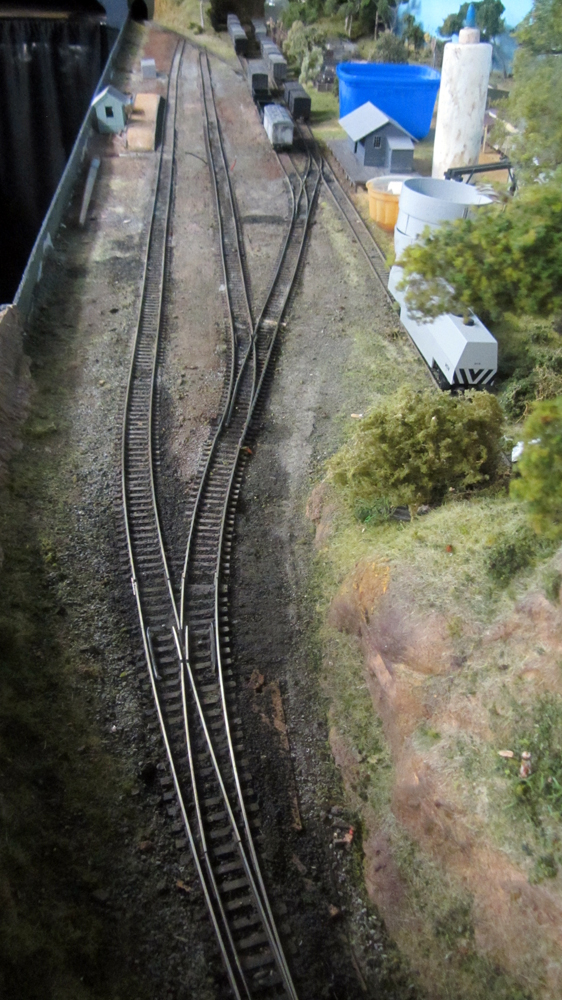
After.
The rearrangement made the whole area look much better, the loop is closer to the main line as it should be, although the curve out is intentional as a water column is to go in between the main line & loop, something that was not uncommon on NSW rails during steam days.With all the trackwork being finished the next thing was to get the 59cl working. Taking the model back to the group member who had built it, he removed the wheel spacers from the 2nd & 3rd set of driving wheels, which has fixed the derailing problem, it runs without any problems into each of the 3 roads now.
The only problem if one can say it is that it needs to have a fair bit of running in, another feature of these kits is often the grinding like noise that comes from them until they get up a bit in speed, the running in will finally bring it line to be put to work, once it has done checks around the other points on the layout. The 57 & 58cl are also getting the spacers removed they too will be tested in the same way, so here's hoping.
So, where are the gnomes? Well the alingnments of the points were the unkowns, owing to the problem being non existant for a large proportion of the locomotive fleet, yet at the same time they were also the visible ones that were causing grief.
Well, just as I was getting quite happy with the way things were going, the hidden gnomes showed up again, as Murphy had a field day, when after some running the 59cl died, no power no having run around the layout around 6 times without any real hitches, it simply stopped. No sign of shorts on the track, so back to running a 36cl & it ran without problem over the whole layout. Then to finish it all, the original Chinese coupler on the TOR 32 decided it too wanted to toss it in, with the jaw spring going missing, causing constant uncoupling, just as well I do not drink Irish Whiskey that would have brought in the Murphy family to the circus.
As per usual, when something happens with couplings especially the large & poor Chinese varities I replay them, so that was carried out using a Kadee Whisker coupler, with no room for a full Kadee box, along with the screw not being long enough to give a decent bite with the box in place anyway, I simply slotted the cover & coupler into the cutout, using some blue tack to hold the cover in place, also removing the rear wheel for ease of access. Screwed in place the whiskers fit neatly in the cutout & work a dream.
Hospital again on Friday for new knee, so the door gets pretty well locked at Essence.
Sunday, 20 September 2015
For a while now I have been trying to concentrate on getting several areas of the layout finished, not that one would notice any real changes as most of them have been in the unseen areas of the layout, in some ways a frustrating time to say the least. However, during this time I have also had a lot of reflecting on the layout & what I want to do & achieve in this minature world of railways.
Early on I decided on making the layout set up with 4 locations plus the staging or transfer yards, this meant having single line working between each of the locations which are quite short in length, one of them around 1.5 metres in length, hardly enough to put signals in place in that section, but that's how it is in model world rather than real world. At the moment I am working on what method of operations to have between the stations, staff, or single line track block, both of which could be readily done, but that's a decision still to come.
Signalling as such is to be all Lower Quadrant types, of the 4 locations I am installing different types of signals to represent the various types that were found around NSW, at least in the main & secondary lines, these are in general different to the untrained eye, but subtle differences were abounding over the NSWGR system.
With that in mind the primary work has been on getting the point work along with the signals into operation at Moblayne, the signals are built by Dale Richards, & in the main they all will have lights in them, this feature has proved to be a right pain in the rear, with the wires breaking on some of them, but those installed so far are fine. The signals at Moblayne have home bracket signals at both ends, being main, loop & rocker arm siding signals lower on the post to enter the yard, this type of signals were found at Werris Creek as well as Moss Vale off the Illawarra line, but here there are 2 different types of bracket signals.
Standard Main Line & Loop starting signals are provided, along with siding signals for yard exit, the siding signals for yard exit were found at Werris Creek for up trains departing South Box. An Outer Home/Inner Distant signal is provided on the down line to protect the future Abatoirs siding, a fixed distant arm along with operating standard sized Home signal is on these types of signals.
Each end of Moblayne has a control panel, Moblayne East & Moblayne West. Down trains approach at East box. The panels when view may well be something that some will raise eyebrows & likely be a point of derision, & something I am hope does not happen. Reason for that is that each road has been given a colour code & pin strip tape used to show the roads, which is really the NSWGR method of having each yard roud numbered, thus my numbers will have colours in both the yard roads & controllers,by using Tam Valley singlets to control signals & points in conjunction with servo's.
I have not used the LED's that come with the Tam Valley products rather I use 3mm LED's of the same colour as shown for the roads, when the points are set for that road. A 3mm warm white is used to show what is the normal lay of the yard points, when reversed to allow a train to enter or depart from a yard road, the colour of the road will be illuminated for its passage as will the appropiate colours for other points leading to the main line.
Habit or should I say operating instructions will need to be instill into operators the mode of doing things in correct order. When train are entering or departing the yard, the first thing to do is ensure the points are all set correctly, before clearing the appropriate signal. Once train has departed or arrived the points are to be reset to normal lay.
In the same way, on the control panel all the Home signals will display red as normal signal, cleared the panel lights will show a green if going through the main line - station, entering the loop will show a yellow, (the usual colour for turnouts on other types of colour light signals). Here is a clear break from what is deemed to be prototypical, but from my perspective the wrong element in the signal board will give crewmen a true indication of which line they are to enter. The Home signals will show a white light rather than a green on the panel when trains are arriving & turning into the yard for shunting or engine change, as white lights will showthe normal lay of the yard points.
The general reasoning behind all of this is to try & prevent something that can be a common problem on layouts generated by some modellers, & that they will stop their train to check the points before moving through them. In some ways that sounds reasonable however, that is the responsibility of the person who will be in charge of the operations at Moblayne, as well as all other station/yards on the layout. The panels are designed to be operated in the same way as a signalman operates the points in the real world & that is points are set prior to clearing the appropriate signal for the movement.
The real world operations in the period I am modelling & for a wide area when I was still on the job, in this case cannot be replicated in full unless one invests heavily in an interlocked lever frame operation, something that is out the question for me. A signalman when starting his shift, only has to look at the frame to know how the points & signals are positioned. When he has to change the points & signals, he has to throw the interlocking lever that is protecting the signals against a wrong operation, any attempt to do so will be met by the lever being locked & unable to be moved until the other levers are pulled in correct sequence, then the appropriate signal can be cleared,
Modelling for me in this way, means that the points have to be thrown correctly first, & then ensure all the points are set correctly for the arrival or departure of a train, before clearing the appropriate signals, the colour lights will show correctly for the movement from the point lights.
This aspect means for me or any layout owner we have to ensure we have our track & especially the point work in top shape, this & the above working outs have meant a fair bit of time occupied on this vital area at the expense of a lot of other things. Knee problems & a replacement scheduled for late October has not help, (Dontcha love getting old with all that free/spare time?)
With the Aussie$$ dropping & a final workout of how many Tam Valley servo controllers I need for the points on the layout, assesed against what I have, meant that I would be needing around 20 of them for full control panel operations, reality stepped in as that would be near enough $U.S250.00 plus shipping.
A drastic rethink therefore was in order so I have begun a process of using mini slide switches with Piano wire & the push pull method of operating them, With some careful work I think I can get away without the need for anymore of the Tam valler controllers, so far two lots of points have been treated along with 4 more ready for the work, I will still look at having all the main line points worked by the servo's & controllers.
The use of operating signals which I had not planned for when I purchased the primary supply when the AU$$ was on the other side of the equation has caused the problem but I think I am a winner anyway.
Sunday, 9 August 2015
No modelling stuff here.
Well, its been some time since my last post, but while a lot has happened, there's not a lot to show for it, hopefully I will be able to provide a better update in a few weeks.
This weekend however, has almost been a right off in many aspects owing to rotten computer issues. I have used Windows 7 64 Pro now for some time, the last few months has actually been great even though the continual updates have been a bit monotenous especially in regard to size, but the speed of boot up, shut down & other aspects of the OS has been worth it.
I was at the same time aware that Microsoft has been working in the background to get us all to use their new wonder OS windows 10, the cheese for the trap was it will be free for Win 7 users, on ThursdayI was notified that I was able to Download the new whizz banger, initially I was reluctant as I was warned of some hours for the process to take place, but having seen how it seemed to work on a laptop at our weekly meeting on Wednesday, Win 10 did seem to look ok, so on Saturday afternoon I took the plunge & decided to go with it, the time I started on was around 200pm.
At 730pm, I was finally able to use my computer after the installation was finished, although it showed I was only 80% complete. 5 1/2 hours left me unimpressed to say the least. then working out how to get my internet working along with some other items took me another 2 hours, that is after I had to try & unscramble the internet settings.
Then the computer would no longer turn off, it would restart after each run down, so I had to to manually push the on button & hold in to turn off. Every time I turned on, & go to the internet, no longer just a click on the task bar icon, but I had to type in IE, or Mozilla to get the web browser & go through security password checks each time.
Boot up takes around 4 minutes as against less than 2 in Win7, the whole of the monitor & personal settings are a mishmash of terrible settings, that has to be the worst I have seen. What, also gets me is the way that so many tasks that are dead easy in Win7 are so much more complicated in 10. But, its not all bad news I guess, as if you are one of the tablet & smartphone thumb operators, then you may well be right at home, even the reviews while casting positive posts, all seem to point out that the new system is pointed towards that medium.
Microsoft they say, are going to change our ways in how we use our computers, the new way is the mobile style, the OS has touch screen & other tablet linkages meaning you may have less need for keyboards, as the monitor can do it for you, if you spend on new ones.
So, for this dinasour, I will stick with Win7 as long as its possible.
Subscribe to:
Posts (Atom)